Monday, November 3, 2008

Let the Challenge Continue


Nicholas Culpepper


It’s the second day in the PAD challenge. I’ve written and posted my poem. The prompt was to make a declarative poem. I created mine with the voice and perspective of Nicholas Culpepper a famous herbalist and physician of his time (1616-1654). Since my theme is Herbs it seemed to fit.
I’m actually pretty unhappy with the last stanza. I just don’t like it and I’m sure there’s a rewrite in the future. Anyone who would care to offer some feedback wouldn’t go unthanked…hint, hint.

Oh! One other thing that I wanted to mention.
Dave, a recent visitor to my blog has a poem on his site in which dialogue was used. I thought this was a really neat idea and so…decided to give it a try myself. Thanks Dave for the inspiration.

Alright – Here it is

Culpepper’s Declaration

“The shrub is so well known by every boy and girl
that has but attained
the age of seven years, that it needs no description.”

How is it now, how could I see
that so few elder
and scarcely a child know - not even by name
or less by sight – Barberry

“The face being washed with the distilled water
of them – cureth the reddest face
that is.”

Cucumbers now
the women slice and like pennies
on the eyes they lie to the
swollen bags dismay.

“The juice of the leaves is a remedy
against the bites of serpents,
and for those that have taken
Aconite.”

Baked in pies to fill the stomach
Mulberry treats now warm
the heart. Feed the body
and the devil’s forgot.

Endless flows of time
resonate adversarial motion toward
arts of old once held dear
now enter this day all things are new
but plants still live and grow
as I find peace beneath them.

Sunday, November 2, 2008

Poetry for You


Well, I’ve noticed that I really haven’t been writing any poetry lately. I’ve been writing, writing fiction, writing articles for two magazines, writing in my blog, even writing some monologues but no.. that’s zero, notta, zip, zilch…poetry. So…

I found myself at the Poetic Asides blog where there is usually some really decent poetic activity going on. I was rewarded with a PAD (Poem A Day) challenge. Robert Lee Brewer has decided to challenge readers to create a chapbook by writing a poem each day that focuses on your chosen theme. He will provide prompts for each day’s writing. Of course, this just seemed to be one of those things that falls into your lap, slaps you in the face, and yells “Hey stupid! Wake up; you wanted to write poetry, well, here’s your chance!”

Um, yes, I heard the call and I’ve decided to go for it. I made my theme “Herbs” and have written the first one. Robert refers to this poem as “The Hook” the one that draws the reader into the theme. I’ll probably be posting quite a few of my PAD poems throughout the month of November. That’s how long the challenge lasts. I hope you enjoy and I would very eagerly welcome any feedback from friends and/or critics.

I seem to have a serious problem coming up with decent names for my poems so this one is still unnamed. If anyone has a suggestion I wouldn’t mind considering it. I don’t know what it is about naming a poem. It’s just so hard for me; nothing ever seems good enough for it. I don’t know *shrug* So, without further ado here’s “The Hook”

Foods ring pungent in my watering mouth
fresh as melting sun and living fire.
Sick bodies are guided back to bloom or
granted merciful passage into summerlands.
Apparel liberated from a lackluster life
released into a world of effulgent hue.
Witness to the sight of flowing fields that dance a tempoed waltz in the wind
they sing in their garments - the bells of mother’s ball.
Bearing alms that are gathered by diverse desire
defenseless immolation scattered to aspirations of imagination.
Generations, heirloom spirit sprawls the boundless sphere,
antics of delicate stature camouflage wellborn privilege;
worshipped by some unnoticed by others
rooted in the soil of human animation.

Wednesday, October 29, 2008

The Mayan Prophecies


I’ll be getting to my topic today in a rather round about way. Not that it makes it so different from other days; I just thought I would mention it. We (my family) have finally arrived in the 21st century; we now have cable TV for the first time. R has wanted it for a while. It didn’t really matter to me as I never watched TV anyway. The kids have wanted it, and now that we can afford it, we decided to go for it.

I have to admit, at this moment, that I have found myself mysteriously drawn to the History channels. We also have some nature and science channels that run a close second for me. So, yes, I have started to watch some TV for the first time in, oh, about 11 years. It’s the TV that brings me to my topic today regarding the book The Mayan Prophecies.

I was watching Ancient Discoveries on one of the History channels the other day. They were investigating the Mayan culture, their calendar, and the prophecies made by one of the known Mayan priests. The prophecies correlate with their calendar, which is amazingly accurate. The Mayan’s had a knowledge of time and astronomy that is unbelievable. It could be seriously argued that the Mayan’s knowledge of these topics actually surpasses our own modern day understanding. That said, if you get a chance to watch the program I would highly recommend that you do.

I noticed, while watching, that the program also had a lot of information that I recalled reading about in a book entitled The Mayan Prophecies by Adrian G. Gilbert. I read the book about, ironically, 11 years ago and I was impressed by the amount of technical information that was made available on Mayan society and their knowledge of science and mathematics. I would also recommend reading the book if you are at all interested in the topic.

According to both sources, it seems that one of the prophecies foretells the end of our age. Now, we’ve all heard the doomsayers and apocalyptic jargon that gets tossed around, but I think this information is worth examining further. The prophecy states that on December 21st (some say 22nd) of 2012 the end of the world (as we know it) will take place. Ouch! That doesn’t give us much time now, does it? But…this post is NOT about doomsday. It’s about the day after.

Here me out here. It’s not just the Mayans who have talked about the destruction of the world as we know it. This has been seen throughout history by many cultures and religions. The Mayans, just happen to have put a date on it. A date that, well if you read the book or watch the show, will seem quite impressively possible. The point here is this. All of these people have claimed it will be the close of the age, including The Bible, depending on the translation you read. It never states it will be the end of the world, that mankind will fail to exist, or that the world itself will fail to exist. It will, instead, be the dawning of a new age.

Now, I don’t know if catastrophe will proceed the new age or not. Heck, I’m just a simple blogger. I do know, that no matter what happens, mankind will be in a position to choose our path. The Mayans also have a prophecy for the new age. They say it will be one of peace, where mankind units, and where religion is not an issue. So, I guess amongst the meandering, my point is really this. I want people to focus on what the world could be. Let’s look at how our lives will be better if, say, we can stop global warming, overcome our need for fossil based fuels, stop the religious wars, feed people, and increase the quality of life. These may seem like dream filled goals here people, but can anyone of you truly claim that they are not worthwhile? With that in mind, and knowing that our ancestors believed that we could make it happen, I guess we’re left with the question…Are we going to make it happen?


Tomb Picture


Lid of Palenque


The Crystal Skull


And what would Halloween be without the picture of the cave spider inside the tomb?

Monday, October 27, 2008

Samhain AKA Halloween


Samhain, pronounced [SAW-hin] is, of course, the original Halloween. Actually, the word itself is Celtic and means November. To the ancient Celts the day signified the beginning of the New Year. The night before the New Year was considered to be an opportune time to communicate with the gods because the veil between this world and the otherworld was at its thinnest. The thin veil, however, worked both ways. Not only did it allow the Celts to speak more easily with their gods, it also allowed beings from the otherworld to cross back over into this world. It was believed that the spirits of the people who had died that year would revisit this world on Samhain eve. To discourage the spirits from coming into the village proper, the Celts would build large bon fires and take offerings to the outskirts of town. They would place the food there in hopes of luring the spirits away.

The Romans considered Samhain sacred as well, however, they called it Pomona Day. To them it was a day of celebration for the end of the harvest. They gave thanks to their gods for their bounty and paid tribute so that the gifts of the harvest would be there again the following year. It was a holiday of tremendous merry making and joy.

Around 500 BC or so, the Romans made their way into the Celtic lands. War ensued and cultures clashed. In the end, the Romans and the Celts managed to combine the holiday traditions and melded beliefs from both cultures. Halloween, the term we know for the holiday, wasn’t actually given until many centuries later when Christianity was introduced to the Celtic lands.

When the Christian faith began to spread, the church found huge amounts of resistance to their pleas to give up the pagan holidays and traditions. They decided it would be more effectual to try and change these holidays into Christian celebrations. With that, they created All Saints Day; on the first of November the Catholic Church honors all of the saints who do not have their own holiday. The night before All Saint’s Day became All Hallows Eve to signify the holy evening. Over the years the term, through mutations of speech, became Halloween. Now, while the church has overtaken many, many pagan holidays, including Easter and Christmas (those are blog entries for another day), in this manner; Halloween just couldn’t be subdued. People enjoyed the celebration too much and the night has now become known to us as a day of spooky mischief making and treats. Yummy.

Somewhere along the line the idea of dressing in frightening costumes also came along. I believe the intent here was to scare off potential spirits that may have meant you harm. I’m not positive on this, but I think it may have come from the Spanish/Mexican influence stemming from their Day of the Dead (November 2nd). So, what are you going to be this year? I plan to hand out goodies to the kids and then sit around with the family telling ghost stories and watching scary movies. Apple bobbing and popcorn balls will most certainly make their appearance as well. America really is a melting pot of culture and our holiday celebrations attest to that fact. Happy Halloween!

Sunday, October 19, 2008

Back to the Drawing Board


Doctor’s, jeez. I wish they would make up their minds. I was sent to a specialist after being told that I had Rheumatoid Arthritis only to be told by the specialist that it may be something else. So, back to the drawing board, they still don’t know what’s wrong.

The doc said that while the one test came back positive for RA not all of my symptoms are matching up and a second more detailed test came back negative. She said that if it was RA I should already have nodules on my hands and I don’t. It seems that the majority of the joint problems I do have are in areas not commonly affected by RA. So…she thinks because the focus is primarily on my back, and hips/pelvis area that I may have Inflammatory Back Disease instead. Supposedly, it’s a disease that is under-diagnosed due to doctors not always recognizing symptoms. The actual non-layman term is Ankylosing Spondylitis and it does seem to be a better fit to the “symptoms” I’ve been having. Both RA and AS are inflammatory diseases, which explains why the symptoms are similar. I guess we’ll have to wait and see…again.

I’m tired of waiting, though, you know? This has been going on far too long. I really just want to know what the heck is happening to me. I have to go in for yet more testing on the 4th. I’m going to have to vote first, though, they said the sedative will make me groggy all day. I should probably just go and vote early like Charmi did, huh? I’m going to have to be sedated for the test. It’s only an MRI but it’s going to be rather extensive which means I’ll need to lie in one position, very still, for about an hour; and well…I can’t do that. Sitting, standing, lying down any which way you look at it I can’t be in one position more that about 10 minutes. I experience way too much pain and stiffness so I have to continually move around, shift my weight, and readjust. And yes, for anyone wondering; it makes it very difficult to sleep at night. In fact, I literally can’t stay in bed more than about 6 hours at a time. I have to get up and move around for a while and I wake up many, many times throughout the night changing positions and sometimes just getting up to walk around.

Crying out loud, I sound like a whinny thing. But, I figured since I had made the previous post after receiving word on the RA that I should make this one too. I know that several of you who read this blog know me, and care about me. Thank you, buy the way. I just want to make sure that you’re in the know and that all the facts are right. I guess I’ll let you know what I know when I know it. Until then, back to life as usual.

Sunday, October 12, 2008

Life Goes On


So I haven’t written again for a while, I know. I had some issues, man. Seriously. Some of you know that I’ve had some health concerns going on for a while now. Well, I’ve gotten new word on my condition. I’ve known for some time that I have Degenerative Disk Disease, that’s why I have so much difficulty with my back and all that lovely sciatic nerve pain. I’ve also been having a lot of other stuff going on too.

Basically, because I haven’t had insurance I’ve been unable to find out for sure what the deal was. I lost my insurance about two years ago. My doctor, at that time, suspected that I had either Lupus or Rheumatoid Arthritis due to the many symptoms I had been displaying. I lost my insurance just before we were able to do the blood work to provide the final diagnosis. That means I’ve gone for the last two years, now, still having to deal with the crap feeling but not knowing what it is or having any way to treat it.

So, enter, HIP, the Healthy Indiana Plan it’s insurance provided by the state for people who do not have insurance due to either their financial status or because their employer does not offer it. Any way, I qualified and now I have insurance. This is a good thing and on a side note I feel I need to say (even though it makes me cringe) that Gov. Daniels did a good thing here with the program. So, insurance. That means I have been able to go to a doctor again. And I did.

I had the blood work done and now we know that I have Rheumatoid Arthritis. This has brought on a lot of mixed feelings for me. On the one hand, it was suspected, so it’s not exactly a surprise, and yet, it still feels surreal. It explains a heck of a lot, like the many, many attacks of pleurisy and the fact that some days I’m literally too sore to walk, or why I can’t grasp objects sometimes. The explanation is there and on a very positive note, now that we know what it is, I can begin treatment.

The way I understand it I have a decent chance of feeling much better once the treatment begins. That would be a welcome relief. I’m pretty tired of feeling crappy all the time, you know? I go to a specialist Friday and then we’ll see how things go. Yet, amidst the good stuff there’s still this lingering feeling of doom. I guess it’s having one’s fears confirmed or something. Maybe it’s just making me feel old. I don’t know. Like I said before, surreal pretty much sums it up. So I find myself caught up with these mixed feelings of hope and depression. I think I need some time to sort it all out. I’m really, really hoping the treatment will make me feel more human again, but after living in this much pain for the last several years I find myself afraid to hope too much. I guess we’ll just have to see. So, there you have it. My update on me. Sorry the post wasn’t more upbeat but…yeah, well, f*ck it. That’s life.

Thursday, September 25, 2008

Earth Series – Deserts


Alright, today’s Earth Series…The Desert. What’s to know? They’re dry, sandy places uninhabitable by living creatures, right? Of course you know that’s wrong. I say this because I trust you, my readers, to know better. But…did you know that they come in second, only to rainforests, for diversity of species? Among those species is us, the human being. While huge portions of desert are unoccupied by people there are those areas that have remained inhabited for tens of thousands of years. Another species that exists there, termites. These guys (and gals) play a pivotal role in a desert ecosystem. The air is too dry to support plant and wood eating fungi so the termites are the source of recycling, without them the ecosystem would collapse.
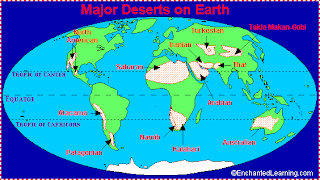
The deserts of the world cover about 1/3 of its surface. They receive somewhere between 0 and 10 inches of rain per year. To put that into perspective, that’s how much rain we received here in South Bend within a 24 hour period after Ike blew its aftermath this way. None of the deserts on the face of the earth are completely lifeless, but there are areas within some deserts that are unable to support life. Nonetheless, life in a desert can be surprisingly evident. In most deserts many animals, reptiles, and insects are nocturnal due to the extreme heat and radiation of the daytime temperatures. The nighttime temperatures fall quickly. The lack of clouds allows the heat of the day to escape into the atmosphere. In the Sahara the temps can drop by 30 degrees. Some of the desert animals include species of fox, toads, scorpions, lizards, and bees. The Sahara even supports life for desert elephants and lions. They cannot survive in the large size herds and prides of the savannah, and they need to travel great distances to find food, but they are present.

So, speaking of the Sahara, it is the size of the United States. It is the world’s biggest source of sand and dust. Sandstorms, the size of Britain, occur without warning and may last for days. Single humped camels (Dromedaries) weather the storms there with little effort. As sands are blown around sand dunes are born. In the midst of these hazardous, life threatening conditions, though, sanctuary is sometimes found in the form of an oasis. These fountains of life exist where the ground water table is very close to the surface and water rises either in springs or is trapped in mountain hallows.

Getting back to the sand dunes here, some of the world’s largest are found in the Namibia desert. They can be as tall as 1,000 feet; grains of sand are blown up the flanks and across the crests of the ridges which means that only the tops of the dunes move. The main body of the dunes in Namibia has not shifted for 5,000 years. As the wind blows across the desert rocks, it carries sand which is continuously eroding the rock slowly turning it to more sand.


The Australian desert has some of the hottest temperatures on earth. Every hour of the day the temperature rises 5 degrees centigrade reaching 70 degrees centigrade (158 degrees Fahrenheit) in the full sun.

The Atacama in Chile is the driest desert on earth; some parts of it haven’t seen rain for 50 years. Still, there is life here. South American camels (Guanacos) survive by eating cactus flowers which provides them with a source of water. But, how do the cacti survive without rain? Hot winds deprive the land of moisture but there is a cold sea current that runs parallel to the land. The cold water cools the air above and fog is made. The wind sweeps the fog inland blanketing the cacti with dew. Many various creatures are dependant on this, the only, source of water in an otherwise dry land. Birds drink the dew drops refreshing and rehydrating themselves. As the winds move inland, though, the air becomes too dry to condense and so there is only a small strip of the Atacama that can support life. Without the fog this portion of the desert would also be uninhabitable.

The Sonoran Desert in Arizona sees more moisture. It receives infrequent and unpredictable rainfalls. Everything there must be ready to take advantage of it. Giant Saguaros, one of the largest cacti, use their large, shallow root systems to take up the water. The pleats on their trunks expand quickly and can store up to five tons of water. Woodpeckers nest in the trunks and the blooms of the saguaros provide food for migrating bats that would not be able to make it across the desert otherwise. BTW – many bats are now endangered throughout the world, and in our own back yard, including the Indiana bat. - This desert is home to some 3,000 plant species, 1,200 bee species, and more than 550 vertebrae species.

Not all deserts are hot, the Gobi receives snow fall instead of rain. The range of temperature here makes this one of the harshest environments on the planet. The snow in the Gobi never melts, the air is too cold and dry and the suns rays evaporate it before it has the chance to become liquid. The snow is the only source of water in the Gobi. It is also home to Bactrian camels (two humps) one of the rarest animals on earth.

Many deserts receive water from distant sources like mountains. The water from these places may run for a hundred miles or more causing a flash flood. It’s not called a flash flood due to an extreme amount of water, but rather because it only lasts for a flash. The water appears and then disappears in as little as the course of a day and only happens once, maybe twice a year. With the flood comes a renewal of vegetation that can support more life in turn. Some seeds may lie dormant in the soil for over 30 years, waiting for this moment. Some massive blooms occur as rarely as one time per century. The greenery will be short lived but it aids in the overall survival of all that inhabit the desert areas.